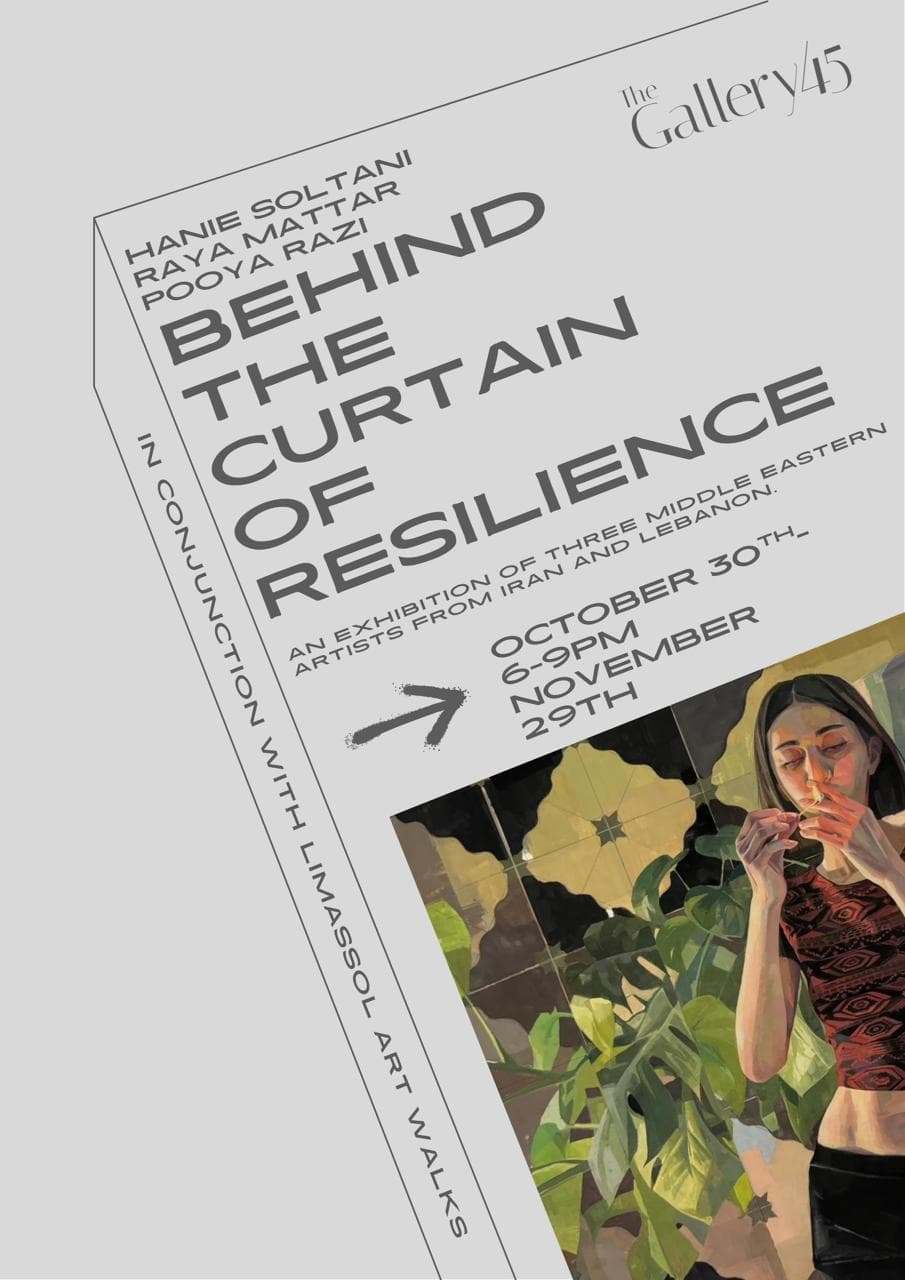
Behind the Curtain of Resilience
Hanie Soltani, Pooya Razi, Raya Matta
30.10 – 29.11 2025
In the context of Iranian and Lebanese artists, the themes of resilience and trauma are particularly resonant, given the historical and sociopolitical challenges faced in both countries.
Artists from Iran, for instance, often navigate a landscape marked by oppressive governmental control, censorship, and social unrest. Growing up in such an environment can significantly influence their artistic expressions and personal narratives. These artists may develop resilience as a response to their often absurd circumstances, channelling their experiences into powerful works that critique authority and explore themes of identity, freedom, and resistance. Their art often serves as a coping mechanism, reflecting adaptive strategies cultivated in response to trauma.
Similarly, Lebanese artists have grappled with the legacies of civil war, political instability, and external conflicts. The traumatic experiences of growing up in a fractured society can foster resilience, leading to artistic expressions that address personal and collective histories. The resilience demonstrated in their work can serve as a form of survival, allowing them to process their experiences and communicate the complexities of their identities.
"I work simultaneously across several projects, drawing on the colour sensibilities and compositional logic of Iranian painting while engaging with figurative Western traditions. I am interested in painting from people and the traces they leave: bodies, objects and interiors that register everyday life and the effects of human presence. Through layered colour, pattern and texture I try to impose a measured attention, a kind of control, on a world that feels loud and chaotic. My paintings move between the observed and the imagined. Some works grow from direct study of the body and still life; others assemble unreal, diaristic compositions shaped by personal and social experience. Fragmented figures and hybrid environments create liminal spaces where memory, desire and social constraint meet. Ultimately I am making a personal vocabulary for thinking about painting, the body and the material world, one that is rooted in tradition but resolutely contemporary."